Written for the trade. If you are an agent, an operator or a MICE buyer appointing a ground partner in the UAE, this is how the mechanics work: net rates, allotments and release periods, rooming lists, fleet licensing, visa sponsorship and the contracting calendar.
Every figure traces to a named source at the foot of the page. Anything not officially published — a 2027 trade-show date, a licence threshold we cannot evidence — is written as unannounced rather than guessed at.
What a DMC is, and what it is not
A destination management company is a locally based business supplying ground services — accommodation, transfers, transport, tours, guides and event logistics — to travel agents, tour operators, OTAs and corporate clients. The commercial distinction is simple: you sell the trip, an operator packages it, and the DMC delivers it on the ground.
The same company may be described as a receptive or inbound operator — the receiving end of the chain, specialising in packages for international travellers arriving in a destination. Dubai's Department of Economy and Tourism is reported to regulate inbound tour operator as its own licence category, separate from outbound tour operator, travel and tourism agent, and appointed general agent for airlines. Ask which category a prospective partner holds. The answer tells you what it can legally do for you.
Two neighbouring terms get used loosely. A tour operator develops the programme — transport, accommodation, attractions, tours and meals assembled into one product. A wholesaler sits between supplier and buyer, building itineraries for others to sell. A DMC can behave like either, but its defining characteristic is physical: contracts, inventory and licensed staff inside the destination. We have been licensed in Dubai since 2016, with the head office in Bur Dubai.
Net rates: why a DMC cannot publish a price
Ask a Dubai DMC for a rate card and you will not get one. That is not coyness; it is how the contracting model works, and it changes how you should read every quote you receive.
A net rate is the gross or best-available rate less commission — the price offered to a trade buyer before that buyer adds its own margin for resale. The gross rate is what the consumer pays, also called the best-available or rack rate: the standard daily rate a hotel publishes on its own site. Commission is the fee paid to intermediaries for selling the product, usually a percentage of the best-available rate.
Net rates are contracted per agent and per season, so there is no single number to publish. A DMC advertising a headline rate has either published one agent's contract — undercutting every other agent it deals with — or published a number it does not intend to honour.
The practical consequence is in how you compare quotes. Two DMCs quoting the same property on the same dates may hold different contracts, different allotment positions and different release terms. The lower number is not automatically better: a rate quoted on request, with no held inventory behind it, can evaporate between quotation and confirmation. Ask what is held, until when, and on what cancellation basis. That comparison predicts whether your group checks in. It is also why every commercial page on this site says request rates rather than carrying a figure.
FIT, GIT and series: three operational disciplines
These three words describe three different businesses inside the same company, using different inventory, lead times and risk positions. A DMC that is good at one is not automatically good at another.
FIT — fully independent travellers
Travellers moving on their own, in couples or in small groups — booked through an agent, but not part of an organised group. Operationally it is defined by speed: bookings arrive ad hoc, each is rate-sensitive on its own, and what you are buying is quote and confirmation turnaround. Most FIT inventory is handled on request, meaning each booking must be confirmed with the supplier before your client can be confirmed. Family programmes sit almost entirely here, alongside the city inventory our hotels pages set out district by district.
GIT — group inclusive tours
Individuals buy a group package and travel a pre-set itinerary: set date, set price, set itinerary. Trade practice puts the minimum group size at roughly ten to fifteen people. Because a GIT departure is contracted ahead on fixed dates, it can be resourced and rate-locked in advance. It is the format most Dubai excursion product is built around — shared desert safaris, dhow cruises and half-day city tours all sell on this basis.
Series — the business a season is built around
Repeating group business: the same organiser, typically the same dates each week for an agreed period, different travellers each time. It is the most valuable inbound business a DMC can hold, because predictable volume across a season is what justifies contracted allotments, dedicated coaches and preferential hotel rates. It also carries the most exposure — if the season underperforms, somebody is holding rooms nobody has sold. Establish who, before you sign.
Allotments, release periods and rooming lists
This is where you find out whether a ground partner operates groups or merely sells them. Three terms govern the whole booking calendar.
An allocation is a pre-negotiated number of rooms, places or seats held by an operator or wholesaler for sale. An allotment is the stronger version: a block of rooms or seats bought out and held by a travel organiser with real purchasing power, cutting the supplier's risk of unsold product and giving the organiser a relative price advantage. Anything not contracted is handled on request instead, where each booking must be confirmed with the supplier before it can be confirmed to the client. Holding allotment is what lets a DMC confirm a series group on the spot rather than going back to the hotel each time — and it becomes a liability the moment the series stops filling.
The release period — also release date, release clause or cut-off — is the point negotiated inside that contract by which held inventory must have been used. Unsold rooms return to the supplier at the release date, typically a set number of days before arrival; four days prior is a commonly cited example, but the figure is negotiated contract by contract. Everything else hangs off that date.
A rooming list assigns each named guest to a specific room. One reservation covers the group and the list tells the hotel who stays where, carrying arrival and departure dates, room types, bedding and sharing, billing instructions, loyalty numbers, special requests such as adjoining rooms or accessibility needs, and any shoulder nights. It is standard for groups of roughly ten rooms or more. It is also the hand-off point between sales and operations, and late or inaccurate lists are the single most common cause of group check-in failure — the list lands after release, the held rooms have gone back to the hotel, and the group is re-quoted on whatever is left.
- 01Enquiry — dates, pax, standard, arrival airport, and any fixed anchor such as a conference session.
- 02Quote — against contracted net rates, stating what is held and what is on request.
- 03Allotment confirmed — rooms blocked, and the release date becomes a fixed calendar item.
- 04Deposit — per contract, and usually the point at which the block becomes firm.
- 05Provisional rooming list — names, room types and sharing, early enough to correct errors while inventory exists.
- 06Release date — unsold held inventory returns to the supplier. Resolve everything before this, not on it.
- 07Final rooming list and numbers — with billing routing and special requests confirmed in writing.
- 08Arrival — manifest, dispatch plan, staffed meeting point, staggered coach release, named 24/7 contact.
Ground handling: what a partner delivers on the day
Ground handling covers everything arranged once travellers reach the destination: arrival and departure management, transfers and coaches, hotel liaison and group check-in, briefed and language-matched guides, excursion delivery and supervision, restaurant and venue reservations, visa processing, manifest control and a 24/7 contact for the length of the programme. Our services pages set out the same scope commercially, and our first-time itinerary guide shows the product an agent is actually reselling. It is bought on evidence of process, not price.
Arrivals and meet-and-greet
At Dubai International the established third-party provider is marhaba, which describes itself as part of The Emirates Group and which dnata places within its premium services division; its published products cover meet and greet on arrival, departure and transit, lounges, marhaba Elite, transfers, baggage services and chauffeur drive. The DMC layer sits on top of that or in place of it: a uniformed representative with a name board, a briefed driver, a welcome pack, a SIM handover and a documented handover to the hotel. For groups it becomes a desk operation with a staffed arrival point and staggered coach dispatch.
For a group the value is not the greeting, it is the dispatch plan — who waits, who goes, how late arrivals are handled, who holds the manifest. Specify the meeting point contractually, because airport meet and greet means five different things across five suppliers. And note that fast-track through immigration is a paid airport service, not something a DMC can conjure; if a client needs it, it must be booked.
Fleet, drivers and the licensing behind them
The graded fleet runs from sedan (one to three passengers, light luggage, point-to-point FIT movements) through premium sedan (VIP arrivals, at-disposal city use) and SUV, to van or minibus (roughly six to fourteen, shared excursion pickups, crew movements) and coach — series groups, conference shuttles and airport block arrivals, the workhorse of MICE ground handling. Safari-specification 4x4s are a separate class with a different licence and vehicle standard from a road SUV; do not let a proposal conflate the two.
The licensing behind the fleet is worth interrogating. As reported by Gulf News and UAE business-setup advisories, the Roads and Transport Authority regulates passenger transport in Dubai, no vehicle may be used commercially as a limousine without RTA approval, and every limousine company must additionally hold a Department of Economy and Tourism trade licence for limousine passenger transport with driver. Chauffeurs must hold a valid UAE driving licence and, separately, an RTA Public Driving Permit; without it a driver cannot legally carry passengers for hire regardless of experience. Drivers are also reported to have to pass RTA knowledge and practical assessments, complete customer-service training and pass a medical fitness test.
Where a coach physically cannot go
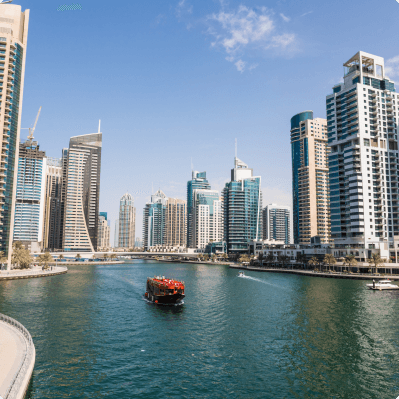
This is the detail that separates a plausible itinerary from a deliverable one, and it is almost never in a proposal. Below is our own set-down guidance by district, built from how groups actually move rather than from a map. Read it alongside a driving time, not instead of one.
Visas: why you need a partner inside the emirate
This is the hardest structural argument for appointing a licensed local partner, and it is not a marketing claim. GDRFA Dubai states that the sponsor or host in the UAE for a single-entry tourist visa should be an establishment working in the field of tourism, and that only accredited tourism offices in the emirate can issue this kind of visa. An overseas agent cannot sponsor that visa itself.
The mechanics for a Dubai-sponsored client: GDRFA Dubai issues the single-entry tourism visa for 30 or 60 days, with processing time stated as 48 hours. Documents are a personal photograph and a passport copy, plus an identity card from the country of origin for applicants from Iraq, Pakistan, Iran and Afghanistan. Conditions are a passport valid for at least six months, a travel ticket to continue the journey or leave the UAE, and medical insurance valid in the UAE. That onward-ticket condition is the one agents most often miss.
For entry into an emirate other than Dubai, the federal route applies: ICP issues visit visas in single and multiple-entry form for 30, 60 or 90 days depending on the duration selected, the holder must enter within the entry permit's 60-day validity from issuance, and ICP may extend provided total stay does not exceed 120 days. Be precise about which authority you are quoting — a Dubai client cannot obtain 90 days from GDRFA. Two more numbers worth carrying: the stated 48-hour processing time is not lead time, since chasing scans and photographs is what consumes the calendar; and ICP publishes an overstay fine of AED 50 per day.
MICE and incentives: what a ground partner owns
MICE covers meetings, incentives, conferences and exhibitions, and the DMC is commonly described as its operational backbone — the party executing on the ground. In a live programme that means itinerary design, venue sourcing and contracting, site inspections, welcome functions and gala dinners from concept through production, pre- and post-conference tours, team-building and CSR activity, all transfers and shuttle logistics, accommodation blocks and rooming, registration and on-site staffing, a 24/7 contact who solves problems when a flight slips, and supplier management consolidated into a single invoice. For a corporate buyer that last item is usually the whole reason a DMC is appointed. Incentive travel — the I in the acronym — is a programme awarded to reward employees, distributors or partners, built from experiences that cannot simply be bought online. Our experiences pages carry the excursion product that feeds it.
On venues, know the two campuses. Dubai World Trade Centre is the emirate's original convention and exhibition campus on Sheikh Zayed Road, operating as the Dubai International Convention and Exhibition Centre, with the Za'abeel Halls, the Sheikh Maktoum, Sheikh Rashid and Sheikh Saeed halls, Al Multaqua Ballroom, majlises, meeting rooms and the Trade Centre Arena. DWTC states it hosts more than 300 events annually and gives the arena capacity as 10,000. Its on-campus hotel inventory is substantial, which changes the transfer plan entirely: many delegates walk to their session, so the DMC's job becomes the off-campus movements and the social programme. Dubai Exhibition Centre at Expo City is a separate site — a programme split across both is a cross-city transfer plan, not a walk.
For plenaries and large-format dinners, Coca-Cola Arena at City Walk opened on 6 June 2019 with a capacity of 17,000, and its retractable seating is the point for MICE: the room scales down for a three-thousand-delegate general session, with simple coach staging around it. For a resort-set conference, the Madinat Jumeirah Conference and Events Centre lists Fort Island, the Joharah, Murjaan and Al Badir ballrooms, Madinat Arena, two majlises, meeting rooms and a boardroom, with venue and hotels on one estate so delegates walk between session and room. Jumeirah publishes no capacity figures for those spaces, so ask for the official chart rather than trusting a venue directory, and contract a hot-weather fallback for anything outdoors. One point of etiquette: Dubai Business Events, the emirate's official convention bureau, offers free impartial support to international organisers, and a competent ground partner works alongside it.
The contracting calendar: when Dubai rates are set
Arabian Travel Market is where DMCs, hotels, airlines, tourist boards and buyers contract for the year ahead, and it is the single most important date in a Dubai DMC's year. For 2026 it does not sit in its long-standing April or May slot: ATM 2026 runs 14–17 September 2026 at Dubai World Trade Centre. Both the official ATM site and the DWTC event listing were re-checked on 29 July 2026 and both carry the September dates. If your contracting plan is still built around April, it is built on stale information. Gulf News reported Danielle Curtis, Regional Portfolio Director at RX Global, on the move, noting that regional tensions had affected flights, logistics and travel plans across the Gulf.
The decision to move Arabian Travel Market 2026 to 14–17 September reflects that ongoing dialogue and collaboration.
gulfnews.com
The knock-on for anyone buying rooms: the September slot collides ATM with the start of the autumn business season, tightening hotels around Dubai World Trade Centre earlier than usual. If you are attending, book on a different assumption from previous years.
The rest of the calendar matters because each of these is a room block that prices you out of a district if you contract late. GITEX moving out of October into December is the change most likely to catch an agent out: it lands on top of the leisure peak.
Two seasonal notes to contract against. December 2026 is the hardest month in the window — National Day on 2–3 December, the Abu Dhabi Grand Prix on 4–6 December, GITEX from 7 December and New Year's Eve, all inside one month. March 2027 stacks Eid al-Fitr, estimated at 9–11 March subject to moon sighting, against Gulfood in the same fortnight. Our Dubai events calendar sets the full demand picture out month by month.
Ten questions to ask before you appoint
Each comes straight out of a mechanic above. A partner that answers all ten crisply is operating; one that deflects on more than two is reselling.
- 01Which licence category do you hold, and will you show me the licence?
- 02Do you hold allotment at the properties you are quoting, or is this on request?
- 03What is the release period on this contract, and what are the deposit stages?
- 04When is my provisional rooming list due, and when is the final one due?
- 05Are your chauffeurs Public Driving Permit holders and your vehicles RTA-permitted? Evidence, please.
- 06If you are quoting a safari inside a protected reserve, are you on that reserve's permitted-operator list?
- 07Who meets my group, at which point in the terminal, and what is the plan for late arrivals?
- 08Can you sponsor the UAE tourist visa yourself, or are you passing it to a third party?
- 09What is your coach set-down plan at each hotel and each stop on this itinerary?
- 10Which attractions here have you confirmed operating status for, on my client's actual dates?
Question six is not padding. Access to the Dubai Desert Conservation Reserve runs through a limited set of permitted operators rather than open public access — one Dubai operator states on its own site that it is one of only a handful of companies allowed to operate inside the reserve. A proposal quoting a reserve safari without an access position behind it is quoting something it may not be able to deliver.
The vocabulary, in plain English
Working with Forever Journeys
Forever Journeys Tours LLC is a licensed Dubai destination management company, established in 2016, head office in Bur Dubai, with branches in Gurgaon, Ahmedabad and Kullu. We handle hotels across the Emirates, airport and inter-city transfers, UAE visa processing, excursions and desert product, yacht charter, and MICE programmes end to end — the scope this article describes, for agents and operators sending clients into the UAE.
We do not publish rates, for the reason set out above. Send dates, passenger numbers, standard and arrival airport, and we will come back with net rates, what is held against them and the release terms attached. Our contact page reaches the reservations desk directly.
Common questions
- What is the difference between a DMC and a travel agent?
- A travel agent sells trips to the public. A destination management company is the B2B partner in the destination that delivers the ground arrangements those trips depend on — accommodation, transfers, transport, tours, guides and event logistics — for agents, tour operators, OTAs and corporate clients.
- Why will a DMC not publish its rates?
- Because net rates are contracted per agent and per season, so there is no single number to publish. A net rate is the gross or best-available rate less commission, agreed in a specific contract. Publishing one agent's rate would undercut every other agent on a different contract, which is why serious ground partners quote on request.
- What is the difference between FIT and GIT?
- FIT — fully independent travellers — are booked through an agent but do not travel as part of an organised group; the business arrives ad hoc and lives on quote turnaround. GIT is a group inclusive tour, where individuals buy a package and travel a pre-set itinerary with a set date, set price and set itinerary. Trade practice puts the minimum GIT group size at roughly ten to fifteen people.
- What is a release period in a hotel allotment?
- The point, negotiated inside the allotment contract, by which the organiser must have used the rooms it is holding. Unsold rooms are released back to the hotel at the release date, typically a set number of days before arrival — four days prior is a commonly cited example, though the figure is negotiated contract by contract.
- When is a rooming list due for a group booking?
- Before the release date, without exception. A rooming list assigns each named guest to a room and carries dates, room types, bedding and sharing, billing instructions and special requests. It is standard for groups of roughly ten rooms or more, and late or inaccurate lists are the most common cause of group check-in failure.
- Can an overseas agent sponsor a UAE tourist visa directly?
- No. GDRFA Dubai states that the sponsor or host in the UAE for a single-entry tourist visa should be an establishment working in the field of tourism, and that only accredited tourism offices in the emirate can issue this kind of visa. That is a structural reason an inbound agent needs a licensed partner in Dubai.
- What is a FAM trip?
- A familiarisation trip — a hosted visit letting a trade buyer or journalist experience the product first hand, so they can sell or write about it from experience rather than from a brochure.
- When do Dubai rates actually get contracted?
- Largely around Arabian Travel Market, where DMCs, hotels, airlines, tourist boards and buyers contract for the year ahead. ATM 2026 runs 14–17 September 2026 at Dubai World Trade Centre, not in its long-standing April or May slot. The 2027 dates were not announced as at 29 July 2026, so confirm with the organiser before planning travel around them.
Sources
Checked 29 July 2026. Travel rules, opening hours and event dates change — we confirm current details for every booking.
- ETAG — the A–Z of travel trade jargon
- Visit Wales — travel trade terminology
- Travel Alliance Partnership — travel and tourism terms
- Xotels — allotment, release period and cut-off definitions
- AltexSoft — rooming list explained
- GDRFA Dubai — single-entry tourist visa service card (fees, documents, sponsor rule)
- ICP — visit visa service card (durations, extensions, overstay fine)
- UAE Government Portal — tourist visa types and application channels
- Gulf News — RTA process for hiring chauffeur-driven limousines
- marhaba — airport services and product families at DXB
- Arabian Travel Market — official site
- Dubai World Trade Centre — Arabian Travel Market 2026 listing
- Gulf News — Arabian Travel Market 2026 moves to September
- Dubai World Trade Centre — our campus (event count, arena capacity)
- GITEX GLOBAL — official site (2026 dates and venue)
- Big 5 Global — official site (2026 dates)
- Gulfood — official site (2027 dates and dual-venue edition)
- Dubai Airshow — official site (2027 dates)
- Dubai International Boat Show — official site
- Jumeirah — Madinat Jumeirah conference and events venues
- Visit Dubai — Dubai Business Events, plan a business event
- Museum of the Future — plan your visit
- Gulf News — Museum of the Future to close in September for a revamp
- Ain Dubai — official site (advance booking window)
- Arabian Adventures — travel trade and destination management services