Most Dubai area guides tell you what a district feels like. This one tells you what each district costs you operationally — which single road closes an entire island, which metro link is a genuine ten-minute walk, which areas coaches cannot reach, and which base is the safe one when a group arrives at two different airports.
Nineteen districts, on the same six fields, from a licensed Dubai DMC's reservations notes. No prices anywhere: rates move weekly and we quote them on request.
Short answer: pick your base in one line
There is no single best area in Dubai, but there is a best area for each type of trip, and the shortlist is small. Six answers cover most visitors.
- First trip, want to walk out and see the thing you came for — Downtown Dubai.
- Beach with atmosphere and street-level dining — JBR, or Dubai Marina one street inland.
- Resort holiday where you barely leave the property — Palm Jumeirah or Umm Suqeim.
- Value, volume and a metro station — Al Barsha, or Deira if you want character over polish.
- Business, meetings or an exhibition — DIFC, or Dubai South if your event is at Expo City.
- Culture, souks and short stopovers — Bur Dubai and Al Fahidi.
How to choose: four questions that decide it
Four questions settle the answer, and the first one is the one nobody asks. Answer them in order and the shortlist above narrows to one or two districts.
Which airport are you landing at?
Dubai has two commercial airports at opposite ends of the city. Dubai International (DXB) is roughly 5 km east of the city centre; Al Maktoum International (DWC) is roughly 37 km southwest. That inverts the answer. Deira is the closest district to DXB by a wide margin and the farthest from DWC. Dubai Marina and JBR are the reverse — the DXB-far, DWC-near side of the city. Dubai South is the one district where DWC wins decisively. For a group arriving on mixed inbounds, Al Barsha is close to equidistant between the two, which makes it the least risky base.
Do you need the metro, or will you be in cars anyway?
The Dubai Metro is run by the Roads and Transport Authority and has two lines today, Red and Green, interchanging at Union and BurJuman. The Red Line runs the Sheikh Zayed Road spine and includes stations at DXB Terminals 1 and 3, so arriving by metro is realistic from that airport. The Green Line runs the creek corridor through Deira and Bur Dubai. Whole districts sit off both: Palm Jumeirah, the Jumeirah coast, Dubai Creek Harbour, Dubai Silicon Oasis and Hatta have no station of their own, and there everything is a car. A Blue Line is under construction with completion scheduled for 2029, but RTA does not publish a full station list, so we do not promise a future station anywhere.
Beach, skyline, or old Dubai?
These are three different cities and they barely overlap. The beach districts — JBR, Umm Suqeim, Palm Jumeirah, the Jumeirah coast — have no metro at the waterfront. The skyline districts — Downtown, Business Bay, DIFC — have the icons, the restaurants and the metro, and no beach at all. Old Dubai — Deira, Bur Dubai, Al Fahidi — has the souks, the abras and the best value, and none of the gloss most first-timers are picturing. Trying to have all three from one base means long transfers; a split stay of two or three nights in each of two districts usually beats a compromise base.
Couple, family, or a group of thirty?
Group size changes the answer more than budget does. Coach access is not uniform across Dubai: Downtown sets coaches down on designated bays rather than at hotel doors, DIFC's basement height limits rule out full-size coaches at most towers, coaches cannot circulate on Marina Walk, and the Al Fahidi lanes are pedestrian-only. Al Barsha and Dubai South are the two districts genuinely built for coach arrivals. For fewer than about a dozen guests, none of this matters and you should choose on character.
The areas most visitors choose
Six districts absorb the overwhelming majority of visitor nights. Each is set out the same way: what it is, who it suits, who it does not, walkability and metro, our transfer estimate, and what we watch operationally.
Downtown Dubai — the postcard
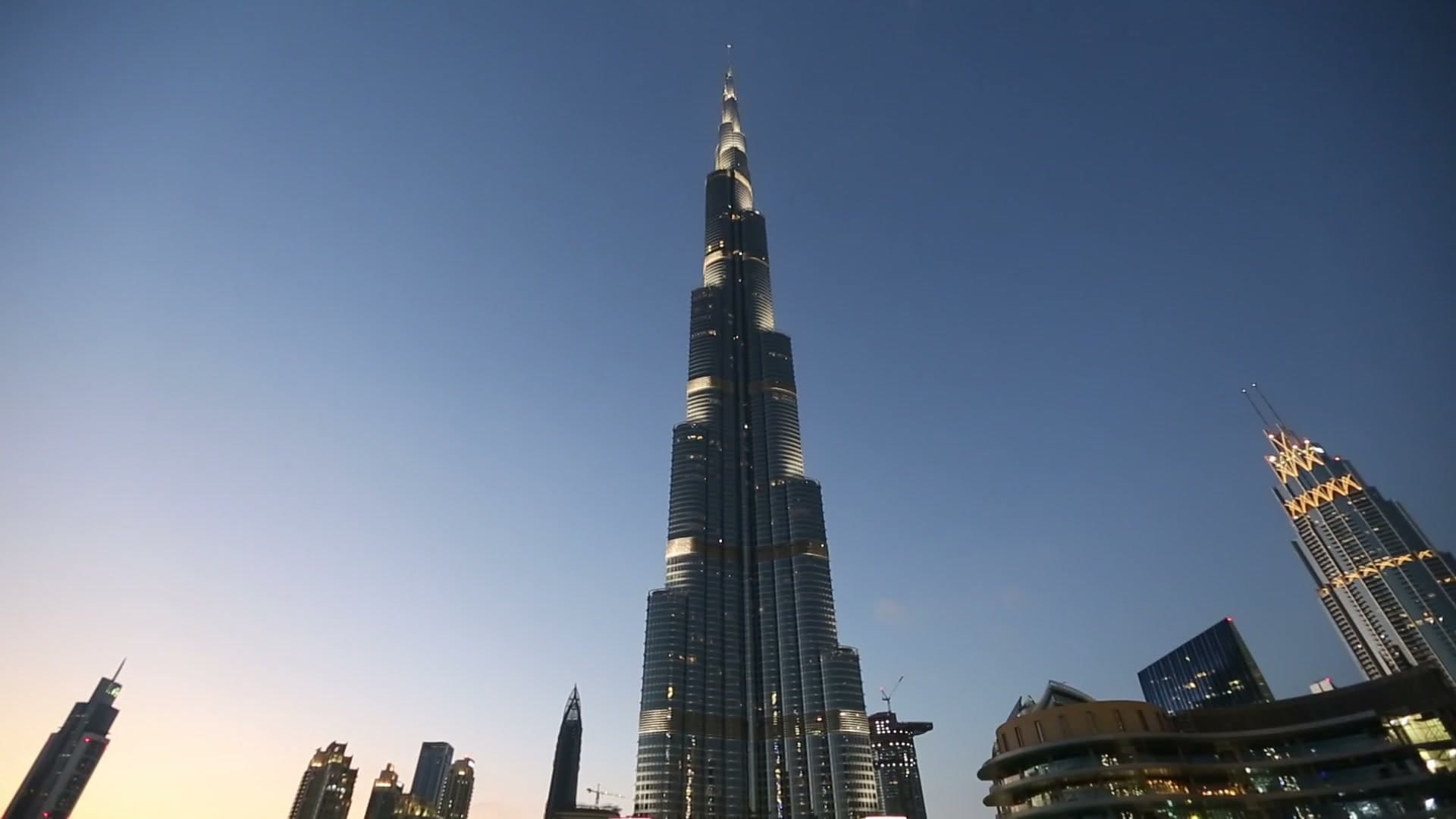
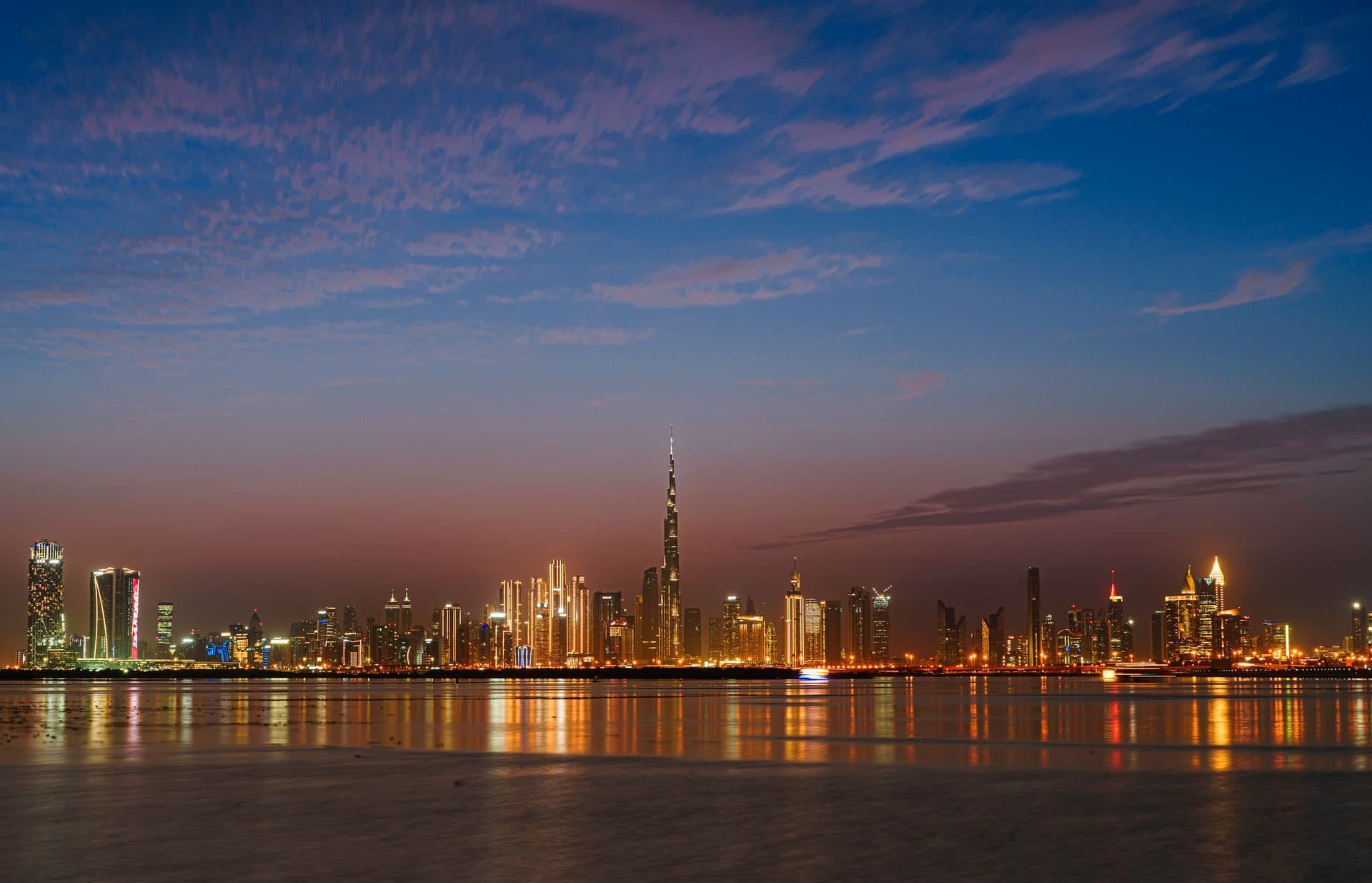
Emaar's flagship central district, built around the Burj Khalifa and The Dubai Mall and framed by the Burj Lake and Mohammed bin Rashid Boulevard. Walkability is high: the mall, the tower, the fountain, Dubai Opera, Souk Al Bahar and Burj Park sit in one loop. Best for first-timers, couples, luxury and business; less good for budget travellers and anyone who wanted a beach. Metro is Burj Khalifa/Dubai Mall on the Red Line — but the link to the mall is a long air-conditioned travelator bridge and a genuine walk, so budget ten to fifteen minutes. Our planning estimate is 20–30 minutes from DXB, 45–60 from DWC. What we watch: Sheikh Zayed Road between Interchange 1 and Interchange 2 at both peaks, the Financial Centre Road approach into the mall car parks (worst on Thursday and Friday evenings), and the gridlock after each evening fountain show — we build fountain timing into an itinerary rather than around it. Hotels here include Address Downtown, Address Sky View, Address Dubai Mall, Palace Downtown, Mandarin Oriental Downtown and Rove Downtown.
Dubai Marina — the evening walk
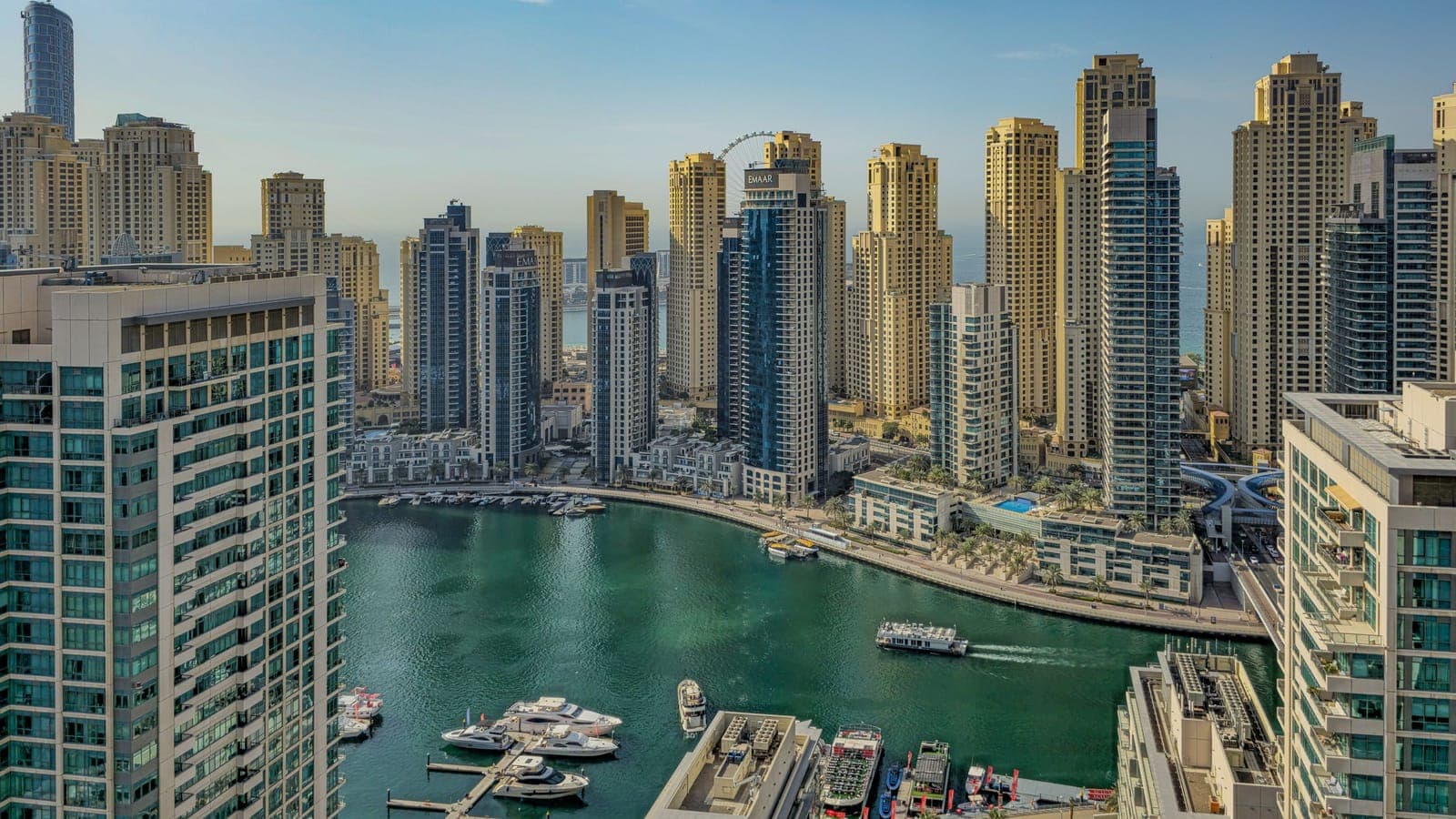
An entirely artificial waterfront district built around a canal cut along the shoreline, established in 2003. The best all-round new-Dubai base: beach at JBR, restaurants at street level, tram and metro on the doorstep and a real after-dark scene. Best for couples, families, younger travellers and long stays; less good for guests who want quiet, or anyone whose meetings are in DIFC or Deira. Metro is Sobha Realty and DMCC on the Red Line, with the Dubai Tram along the corridor and an RTA water taxi serving four marina stops. Our estimate is 35–50 minutes from DXB, 25–35 from DWC. What we watch: Interchange 5 is the Marina's only high-capacity entry and it backs up at both peaks, and Al Marsa Street and the Marina Walk loop are one-way and narrow — coaches cannot circulate there at all. Hotels here include Grosvenor House, Vida Dubai Marina & Yacht Club, W Dubai – Mina Seyahi, Le Royal Meridien Beach Resort & Spa and Ciel Dubai Marina.
Jumeirah Beach Residence (JBR) — the boardwalk
A dense beachfront strip immediately seaward of the Marina, fronted by The Walk and The Beach. The rare Dubai beach that is genuinely public — which is exactly why it is crowded and noisy on Fridays, Saturdays and every public holiday. Best for families, couples and value beach stays; wrong for business and for anyone expecting a secluded resort beach. Walkability is high, the JBR 1 and JBR 2 tram stations serve the strip directly and Sobha Realty is the nearest metro. Our estimate is 35–50 minutes from DXB, 25–35 from DWC. What we watch: permanent valet congestion on The Walk service road from late afternoon, beach car parks filling by mid-morning at weekends, and coach set-down on the outer service roads. The month you travel changes how usable the beach is — our separate guide to the best time to visit Dubai covers sea temperature and holiday crowding. Hotels here include The Ritz-Carlton Dubai, Address Beach Resort, Rixos Premium Dubai JBR, FIVE LUXE JBR and Amwaj Rotana – JBR.
Palm Jumeirah — the resort island
An artificial archipelago developed by Nakheel, divided into a trunk of towers, residential fronds and an outer crescent of flagship hotels. Buy the Palm for the resort, not the location: once a guest is on the crescent they are committed to taxis for everything off-island. Best for honeymoons, luxury and resort-led family stays; poor for business, budget, and anyone without a car who wants to explore. Walkability is low — the island is not a walking environment. Our estimate is 40–55 minutes from DXB, 30–45 from DWC. What we watch: the trunk is the single road on and off the island, so one incident closes the whole Palm; the crescent has no U-turns for long stretches and a missed turn is expensive; coach access is good at the big crescent resorts and poor on the fronds. Hotels here include Atlantis The Royal, Atlantis The Palm, One&Only The Palm, Waldorf Astoria Dubai Palm Jumeirah, Sofitel Dubai The Palm, Fairmont The Palm, Anantara The Palm Dubai Resort, FIVE Palm Jumeirah, Raffles The Palm Dubai and Jumeirah Zabeel Saray.
Please be advised that Monorail service is temporarily suspended until further notice due to maintenance.
palmmonorail.com
That notice was on the Palm Monorail's own site when we checked it on 28 July 2026. Until service resumes, every movement on Palm Jumeirah is a road movement — budget more vehicle time than the map suggests.
Umm Suqeim — the Burj Al Arab coast
The coastal district southwest of Jumeirah, holding Madinat Jumeirah, Wild Wadi, Kite Beach and Sunset Beach. Where guests stay when they want that stretch of coast in the window. Best for luxury, honeymoons, resort family stays and active beach guests; less good for business and for anyone relying on public transport. Walkability is medium and the metro is inland at Mall of the Emirates and Equiti, so the beachfront needs a short taxi leg. Our estimate is 30–45 minutes from DXB, 35–50 from DWC. What we watch: Jumeirah Road along the beach strip on weekend afternoons, the Umm Suqeim Road interchange onto Sheikh Zayed Road, and street parking at Kite Beach and Sunset Beach that saturates by mid-morning at weekends. We brief drivers on the legal view pull-ins rather than letting guests improvise on Jumeirah Road. Hotels here include Jumeirah Al Naseem, Jumeirah Al Qasr, Jumeirah Mina Al Salam, Jumeirah Marsa Al Arab and Jumeirah Beach Hotel — but read the closures section below before you commit to this district.
Business Bay — Downtown's working neighbour
A dense high-rise district immediately south of Downtown, wrapped around the head of the Dubai Water Canal. Same skyline, canal frontage, calmer streets, and a much wider hotel-apartment supply for extended stays. Best for business travellers, value-conscious couples, long stays and families needing apartments; less good for a beach holiday or a street-level dining scene. Walkability is medium, with Business Bay and Burj Khalifa/Dubai Mall both on the Red Line, and our estimate matches Downtown at 20–30 minutes from DXB, 45–60 from DWC. What we watch: Al Khail Road and Sheikh Zayed Road feeder ramps at both peaks, and Marasi Drive and Al Abraj Street, which are single-lane in places and jam on check-in waves. This is our standing fallback when Downtown sells out for a citywide event — sell it on canal views and the walk to Downtown, not on nightlife. Hotels here include Taj Dubai, The Lana, Dorchester Collection and JW Marriott Marquis Hotel Dubai.
Areas most guides skip — and who they're right for
Thirteen more districts, none of which appear in a standard six-area listicle, and several of which are the correct answer for a specific trip.
DIFC — business, galleries and dinner
A financial free zone in a central location, organised into Gate Village, Gate District and Gate Avenue. Gate Avenue is a continuous covered pedestrian spine, which makes DIFC one of the few genuinely walkable business districts in the city. Best for corporate and MICE guests, art-led travellers and couples who came for the restaurants; less good for families, beach and budget. Financial Centre and Emirates Towers are both on the Red Line, and Emirates Towers is connected to the Museum of the Future by a link bridge. Our estimate is 20–30 minutes from DXB, 45–60 from DWC. The internal ring is one-way and confuses drivers, so we brief on the specific tower entrance, and basement height limits rule out full-size coaches at most towers. Walking distance to the World Trade Centre makes it a high-value delegate base. Hotels here include Waldorf Astoria Dubai International Financial Centre, The Ritz-Carlton DIFC, Four Seasons Hotel DIFC and Jumeirah Emirates Towers.
Jumeirah, La Mer and J1 Beach — low-rise, no metro
A long low-rise coastal band running southwest from the city centre, taking in the La Mer waterfront and the J1 Beach club strip. The area for a guest who has already done Downtown and the Marina and wants Dubai at human scale. Best for couples, quiet family stays, repeat visitors and boutique hotels; less good for budget, big-group logistics and anyone who needs the metro. There is no metro on the coast at all — the nearest Red Line stations sit inland on Sheikh Zayed Road, so every guest movement is vehicular. Jumeirah Road is two lanes with heavy school traffic on weekday mornings, and coaches do not work here; we use minivans. Our estimate is 25–40 minutes from DXB, 40–55 from DWC. Hotels here include Bvlgari Resort Dubai, Mandarin Oriental Jumeira and Four Seasons Resort Dubai at Jumeirah Beach.
Bluewaters Island — small, walkable, one bridge
A compact Meraas island off JBR, anchored by Ain Dubai, with a waterfront retail and dining quarter. Walkable end to end and pleasant for a couple or an evening, but inventory is small, so we usually sell it as an add-on to a Marina or JBR stay rather than a base. A single road bridge is the island's only vehicle access and it shares the Interchange 5 approach. For groups, the reliable move is to drop at JBR and walk the pedestrian footbridge, which bypasses the bridge queue entirely. Our estimate is 35–50 minutes from DXB, 25–40 from DWC.
Al Barsha — the value base with a mall-linked station
An inland district on Sheikh Zayed Road built around Mall of the Emirates and its metro station, with deep midscale and upper-midscale supply. This is the workhorse: when a series or a large group needs volume at a sane rate with metro access, Al Barsha is usually the answer. The Mall of the Emirates station is directly connected to the mall and is one of the few Dubai stations with a genuinely short indoor link. Most hotels here are built for coach and group arrivals. Our estimate is 30–45 minutes from either airport — that near-equidistance is why it is the safest base for a mixed-arrival group. Watch the mall roundabout and car park exits on weekend evenings. Hotels here include Kempinski Hotel Mall of the Emirates and Citymax Hotel Al Barsha.
JLT — the Marina's quieter twin
Residential and commercial towers arranged around man-made lakes, immediately inland of the Marina across Sheikh Zayed Road, and home to the DMCC free zone. One metro stop and a footbridge separate a JLT rate from a Marina rate, which is the whole argument for it. Best for business, budget, long stays and value couples; less good for first-timers, beach holidays and luxury. DMCC and Sobha Realty are both on the Red Line, with a tram station a short walk away. Cluster access roads are single-entry loops, so a wrong turn means a full loop back. Our estimate is 35–50 minutes from DXB, 25–35 from DWC.
Deira — trading Dubai, and the closest base to DXB
The historic commercial quarter on the north bank of Dubai Creek — gold, spice and the harbour that made the city a trading port. The best value in Dubai and the most authentic, but manage expectations: this is a working commercial district, not a resort quarter. Best for budget, culture-led travellers, trade visitors and short stopovers; wrong for beach holidays and anyone expecting glossy Dubai. Metro access is the best in the city for a heritage district: Gold Souq, Al Ras and Baniyas Square on the Green Line, Union as the Red/Green interchange, and City Centre Deira on the Red Line, plus abras across the creek. Our estimate is 10–20 minutes from DXB — and 50–70 from DWC, the longest routine transfer in the emirate. Souk lanes are pedestrian-only, so coaches set down at Baniyas Square or the abra station and walk in. Hotels here include Marriott Marquis Dubai Creek, Hyatt Regency Dubai and Al Bustan Rotana.
Bur Dubai — souks, abras and the oldest streets
The south bank of the creek: the Textile Souk, Meena Bazaar, Al Fahidi and Al Seef. It is also where our own head office is. The most atmospheric budget base in Dubai and the natural start point for any heritage itinerary. Al Ghubaiba and Sharaf DG on the Green Line, BurJuman as the interchange and ADCB on the Red Line. Our estimate is 15–25 minutes from DXB, 45–65 from DWC. Coach access is poor in the historic core — use the Al Seef or Al Ghubaiba set-downs. The half-day we run most often from here is the best-value cultural product in the city: abra crossing, souks and Al Fahidi on foot, all inside a compact radius with no vehicle needed. Hotels here include Citymax Hotel Bur Dubai and Grand Hyatt Dubai.
Al Fahidi and Al Seef — the heritage half-day on foot
A paired destination inside Bur Dubai: Al Fahidi is the genuine restored historic quarter along the creek, Al Seef the adjacent heritage-styled waterfront with retail, dining and its own abra station. The strongest cultural product in Dubai and the easiest sell to guests who arrive believing the city has no history. We run them as one loop — Al Fahidi on foot, abra across, souks, abra back, sunset at Al Seef — which needs no vehicle between stops and is therefore unusually resilient to traffic. Al Seef parking is limited and fills from late afternoon; Al Fahidi is pedestrian-only inside the quarter. This is the district where the guided experiences we run earn their keep.
Dubai Creek Harbour — new-build, near DXB, no metro yet
A large Emaar waterfront masterplan on Dubai Creek beside the Ras Al Khor Wildlife Sanctuary, taking in Creek Beach, the Island District, The Cove and Harbour Views. Sell it for space and for the view back at the Downtown skyline; do not sell it as central. The Green Line terminus at Al Jaddaf is the nearest station and it does not serve Dubai Creek Harbour directly, so a road leg is always required. Coach access is good — new roads, wide set-downs — and our estimate is 15–25 minutes from DXB, which is its real advantage. Best for repeat visitors and long stays; poor for first-timers and anyone without a car.
Dubai South and Expo City — the airport city
The far-south corridor around Al Maktoum International, containing Expo City Dubai, the legacy district of Expo 2020. Sell it on airport and event proximity, never on location — it is a long way from everything a leisure guest came to see. Expo City itself is a shaded, walkable campus; the wider corridor is not walkable at all. The Expo 2020 station is the terminus of the Red Line's Route 2020 branch, and branch headways differ from the main line, which matters for delegate movements. Coach access is excellent and purpose-built for mass event movement. Our estimate is 10–20 minutes from DWC against 45–65 from DXB — the one district where DWC wins decisively. The operator names Rove Expo City and Cheval Maison as on-site accommodation, and publishes around 9,500 parking bays across four zones.
Dubai Silicon Oasis — free-zone business, no metro
A free-trade zone and residential community at the intersection of Dubai–Al Ain Road and Sheikh Mohammed Bin Zayed Road, next to Academic City, now one of three zones under the Dubai Integrated Economic Zones Authority. A specialist base: recommend it only when the guest's business is in DSO, Academic City or the Al Ain corridor. It has no metro station today — we checked that against the full Red and Green Line station lists — and no metro fallback if the road network fails. Coach access is good on wide modern roads. Our estimate is 25–40 minutes from DXB, 50–70 from DWC. It is also a useful overnight staging point for Hatta and Oman-border programmes.
Al Quoz and Alserkal Avenue — a visit, not a stay
A large industrial and warehouse district between Sheikh Zayed Road and Al Khail Road, now best known for Alserkal Avenue. Being direct about it: there is essentially no visitor accommodation here, and we would not put a guest in Al Quoz. Programme it as an afternoon or an evening from a Downtown, Business Bay or Al Barsha base. Alserkal Avenue is a compact walkable compound; the surrounding industrial grid is not. Coaches struggle in the Avenue's lanes, so we use minivans or set down on the perimeter.
Hatta — Dubai's mountains, a day out rather than a base
An inland exclave of the emirate about 134 km east of the city, set in the Hajar Mountains and bordering Oman. Higher elevation means cooler temperatures and lower humidity than the coast. It is the best answer to "what else is there?" inside Dubai's own borders, but it is a day-trip or an overnight, not a base — there is no rail access and the mountain roads are slow. Best sold October to March; summer heat undercuts the outdoor product. Weekend convoy traffic to the dam builds from mid-morning and dam parking fills early on Fridays and Saturdays. Because Hatta is an exclave on the Oman border, confirm current routing and what documents guests need before any group is dispatched.
What's closed right now
Several landmark properties are physically out of service as we publish this. A blog post that ignores that will send you to a building site. Everything below was checked on 29 July 2026.
- Jumeirah Burj Al Arab — closed. Jumeirah confirmed on 15 April 2026 that the hotel had temporarily closed for a restoration reported at around 18 months. No firm reopening date has been published, and we will not print a reopening quarter that nobody has announced.
- Armani Hotel Dubai, inside the Burj Khalifa — closed from 1 April 2026 for a full refurbishment, with a reopening target of Q4 2026 reported by Arabian Business, Hotelier Middle East and Khaleej Times.
- The St. Regis Dubai, The Palm — guest rooms and the spa closed from 12 April 2026 under a Property Enhancement Program. Khaleej Times reports bookings unavailable through 31 August 2026 and resuming from 1 September 2026. Not confirmed by the hotel itself.
- One&Only Royal Mirage — The Palace wing closed for renovation from 24 April 2026 until further notice, and The Residence & Spa also closed. Arabian Court appears to be the only bookable wing.
- Park Hyatt Dubai — closed from May 2026. A November 2026 date is showing on booking platforms but has not been confirmed by Hyatt, so treat it as indicative only.
- Anantara World Islands Dubai Resort — this one is permanent. Operations ceased on 10 April 2026 and it is not coming back. It is not the same property as Anantara The Palm Dubai Resort, which is open.
- Bollywood Parks Dubai — closed permanently in 2023. Real Madrid World opened on that site in phases across 2024 and 2025. Any itinerary you are shown that still lists Bollywood Parks is out of date.
All 19 areas at a glance
Best area to stay in Dubai for…
…your first trip
Downtown Dubai. You walk out of the hotel into the thing you flew for, the metro is on the doorstep and the transfer from DXB is short. The alternative is Dubai Marina if you would rather have a beach within walking distance than the tower. The trade-off is simple: Downtown has no beach, and the Marina has no icons.
…families with young children
JBR, because the beach is public, free and directly in front of the hotels, and there is food at street level rather than only inside resorts. The alternative is Al Barsha for families watching the budget — metro-linked, a big mall next door, and hotels used to family volume. The trade-off at JBR is noise and crowds at weekends.
…a honeymoon
Palm Jumeirah, for resorts built around privacy and a beach you never share with a public car park. The alternative is Umm Suqeim, which gives you the same resort quality with easier access to the rest of the city. The trade-off on the Palm is isolation: one road on and off, and taxis for everything.
…a beach holiday
Umm Suqeim for a resort beach, JBR for a public one. That is genuinely the whole decision. Check the closures list above before you fix on Umm Suqeim, and check which month you are travelling — the difference between a February beach day and an August one is not marginal.
…business and meetings
DIFC, because you can walk between the towers, the World Trade Centre and dinner. Business Bay is the value alternative one district south. If your event is at Expo City or the Dubai Exhibition Centre, none of that applies — stay in Dubai South and save yourself two hours a day.
…a short stopover
Deira, or Bur Dubai across the creek. Our planning estimate from DXB is 10–20 minutes to Deira, which is the shortest routine transfer in the city, and both districts put a genuine half-day of sightseeing within walking and abra distance of the hotel. If you land at DWC instead, invert this completely: stay in Dubai South or the Marina.
…a group of thirty or more
Al Barsha first. It is built for coach arrivals, it holds volume at a sane rate, it is metro-linked, and it sits close to equidistant between the two airports, which removes the single biggest risk in group logistics — mixed arrival airports. Dubai South is the right answer when the event is at Expo, because the coach infrastructure there was designed for mass movement. Downtown will absorb a large group because it has the highest-density hotel cluster in the city, but coach set-down is on designated bays rather than hotel doors and a badly timed transfer costs you a long delay. Group blocks, coach movements and hotel contracting are what our services page covers, and agents can ask for net rates and allotments directly.
Common questions
- What is the best area to stay in Dubai for first-time visitors?
- Downtown Dubai. It puts the Burj Khalifa, The Dubai Mall, the fountain, Dubai Opera and Souk Al Bahar inside one walkable loop, and it sits on the Red Line. The main caveat is that there is no beach, so pair it with beach days or split the stay with the Marina or Umm Suqeim. Note that the metro station is linked to the mall by a long travelator bridge — budget ten to fifteen minutes for that walk rather than treating it as a station exit.
- Is it better to stay in Downtown Dubai or Dubai Marina?
- Downtown if you want the landmarks and a short transfer from Dubai International; Dubai Marina if you want a beach, an evening walk and street-level restaurants. The deciding factor is often the airport. Our planning estimate from DXB is 20–30 minutes to Downtown but 35–50 to the Marina, and from Al Maktoum International the maths inverts: 45–60 to Downtown, 25–35 to the Marina.
- Which area of Dubai has the best beach for families?
- JBR. The beach is genuinely public, it runs directly in front of the hotels, and The Walk and The Beach put restaurants and shops at street level rather than inside a resort. The trade-off is that a public beach is a busy beach: JBR is crowded and loud on Fridays, Saturdays and every public holiday, and the beach car parks fill by mid-morning at weekends. Families who want a quiet resort beach should look at Umm Suqeim or Palm Jumeirah instead.
- Do you need a car to stay on Palm Jumeirah?
- In practice, yes — or you will be taking taxis constantly. Palm Jumeirah has low walkability: you can walk within your own resort, Nakheel Mall or The Pointe, but the crescent is a highway and the island is not a walking environment. The Palm Monorail was showing as temporarily suspended for maintenance on the operator's own site when we checked on 28 July 2026, so every movement on the island is currently a road movement. Add to that the fact that the trunk is the only road on and off the island, so one incident closes the whole Palm.
- Which Dubai areas are on the metro?
- The Red Line runs the Sheikh Zayed Road spine and serves Downtown, Business Bay, DIFC, Al Barsha, Dubai Marina and JLT, with a Route 2020 branch to Expo City. The Green Line runs the creek corridor and serves Deira, Bur Dubai and Al Fahidi. The two interchange at Union and BurJuman. Districts with no station of their own include Palm Jumeirah, Bluewaters, the Jumeirah coast, Dubai Creek Harbour, Dubai Silicon Oasis and Hatta. A Blue Line is under construction with completion scheduled for 2029, but RTA has not published a full station list, so nobody should be promising you a future station anywhere.
- Where should I stay for a short layover in Dubai?
- Deira, if you are landing at Dubai International. It is the closest district to DXB by a wide margin — our planning estimate is 10–20 minutes — and it puts the Gold Souk, the Spice Souk, the creek and an abra crossing within walking distance of the hotel, so a half-day of real sightseeing needs no vehicle. Bur Dubai across the creek does the same job. If you are landing at Al Maktoum International instead, do not stay in Deira: that is 50–70 minutes on our estimate, the longest routine transfer in the emirate.
- Which Dubai area is closest to Dubai International Airport?
- Deira, at 10–20 minutes on our planning estimate, followed by Bur Dubai, Al Fahidi and Dubai Creek Harbour at 15–25. Dubai International sits roughly 5 km east of the city centre, which is unusually central for a major hub, but every transfer from it crosses live city traffic — so padding for the time of day matters more than the distance does.
Sources
Checked 29 July 2026. Travel rules, opening hours and event dates change — we confirm current details for every booking.
- Roads and Transport Authority — About Dubai Metro (Blue Line status and 2029 target)
- Roads and Transport Authority — Marine transport (abra and water taxi routes)
- Dubai Airports — Metro connections from DXB Terminals 1 and 3
- Dubai Airports — Al Maktoum International (DWC) history and scale
- Palm Jumeirah Monorail — service status notice (checked 28 July 2026)
- Expo City Dubai — Plan your visit (access, parking, on-site accommodation)
- Visit Dubai — Downtown Dubai neighbourhood guide
- Visit Dubai — Deira neighbourhood guide
- Visit Dubai — Bur Dubai neighbourhood guide
- Visit Dubai — Al Quoz neighbourhood guide
- Visit Dubai — Nature and adventures in Hatta
- Meraas — Bluewaters
- Dubai International Financial Centre — official site
- Dubai Integrated Economic Zones Authority (Dubai Silicon Oasis governance)
- The National — Jumeirah Burj Al Arab closes for an 18-month restoration (15 April 2026)
- Arabian Business — Armani Hotel Dubai closes, Q4 2026 reopening target
- Khaleej Times — The St. Regis Dubai, The Palm: bookings unavailable during refurbishment
- Khaleej Times — Dubai hotels under renovation in 2026 (Armani, Park Hyatt, Radisson)
- Khaleej Times — Anantara World Islands Dubai Resort ceases operations