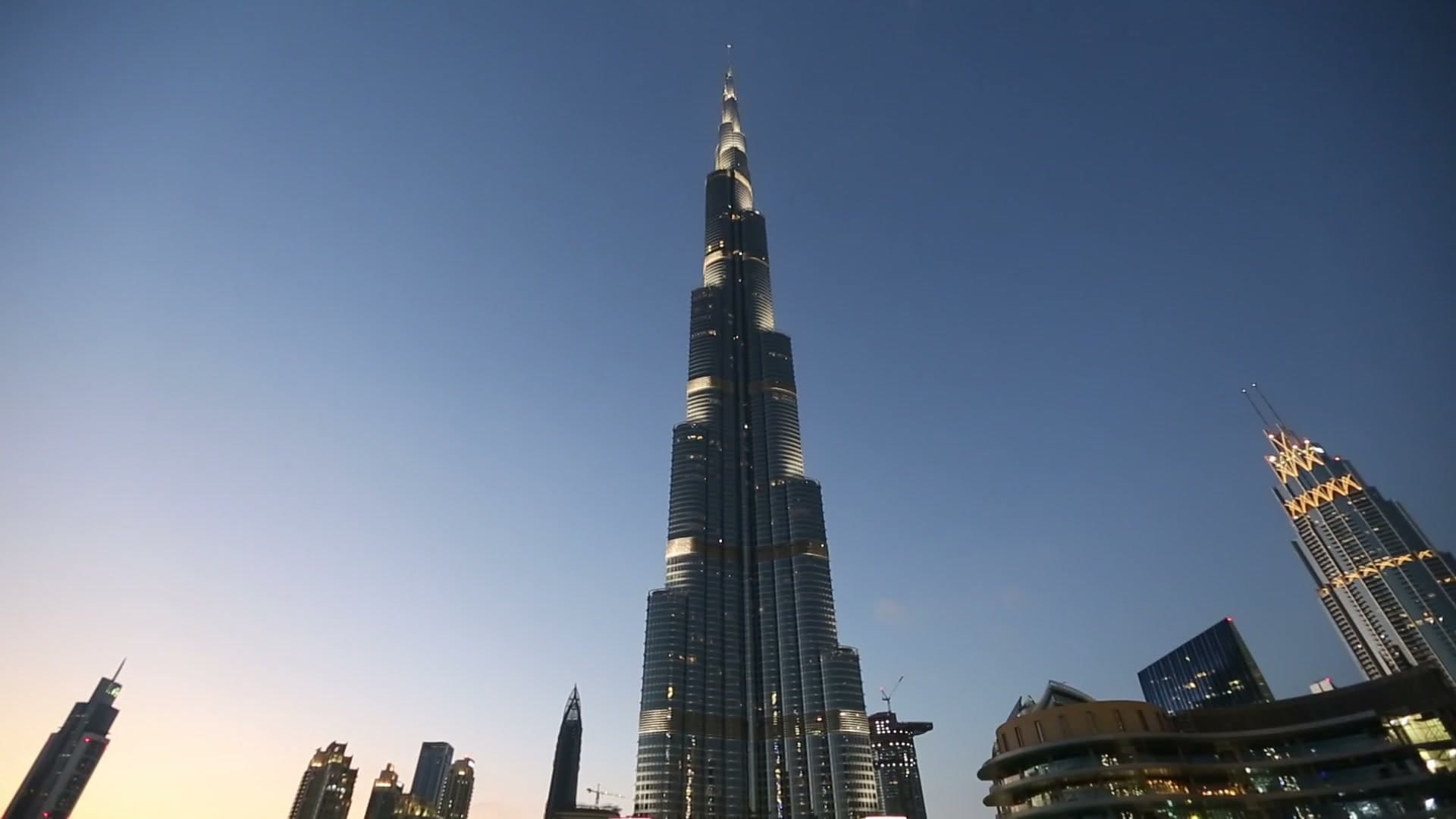
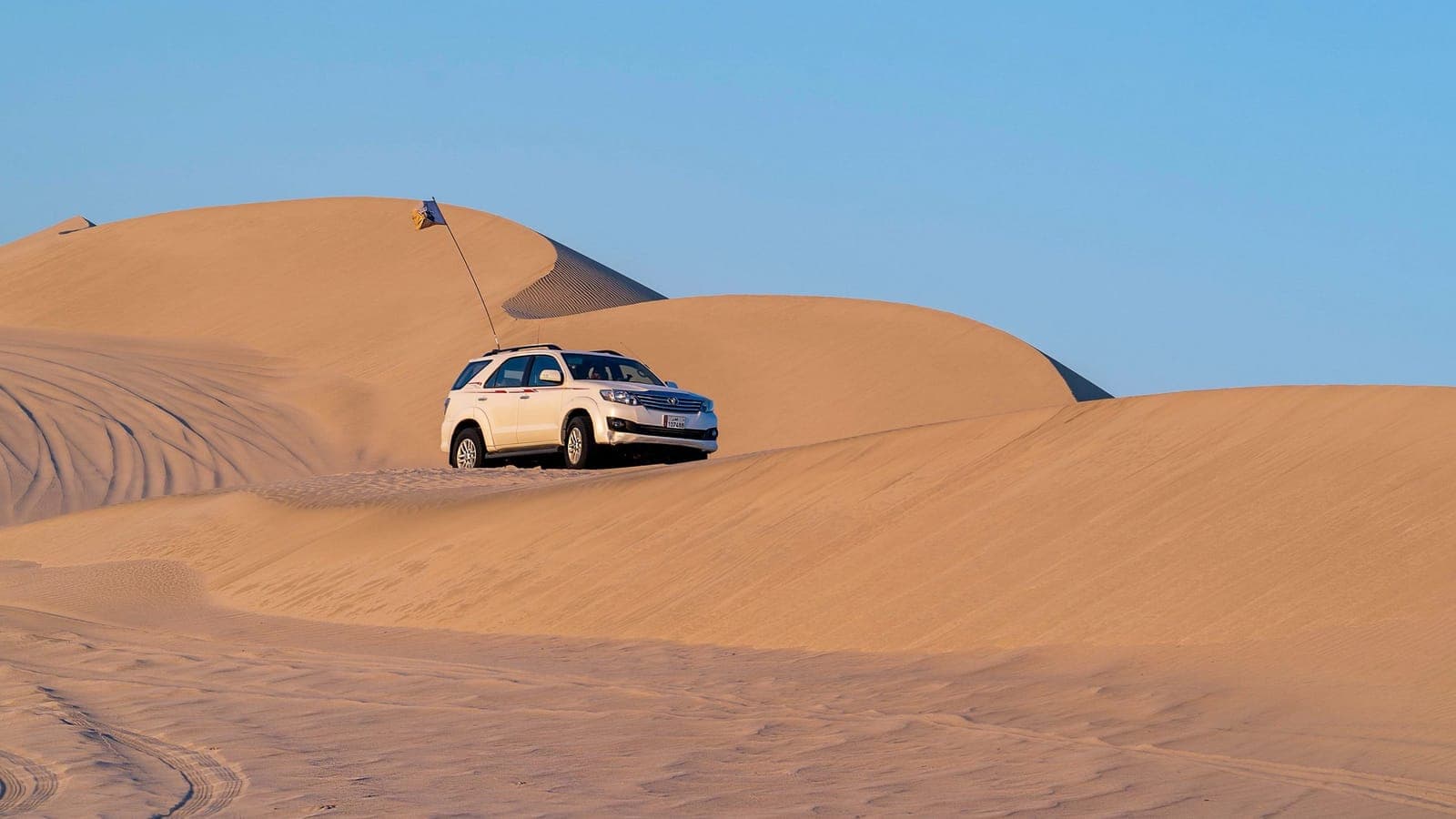
A desert safari is the most price-shopped product in Dubai, which is exactly why the quotes in your inbox are so hard to compare. Two of them can differ enormously and both be honest, because they are running in different deserts, under different access rules, with different vehicles and different camp sizes.
This is the operator's version: the six formats that exist, what each includes, what is quietly left out, and the six things that go wrong on the day.
Short answer: which safari to book
Book an evening safari if it is your first time and you want the whole sequence — dune driving, sunset, camp, dinner, show. Book a morning safari if you are travelling June to September, have young children, are prone to motion sickness, or have an evening flight. Book a conservation-reserve safari if you want wildlife, a certified guide and a quiet camp instead of a convoy. Book an overnight if the sunrise is the point. Book a culture-led reserve experience at Al Marmoom if you do not want to be thrown around a dune at all.
Then the line nobody selling one product will write for you: the cheapest quote in your inbox and the most expensive one may be operating in completely different deserts. The credible differentiators are which desert the safari actually runs in, how exclusive the camp is, how old the vehicles are and how good the guide is. Headline price tells you almost nothing about any of them.
The six formats, compared
Most comparison articles put two formats side by side, morning against evening, because the operator writing them sells both. Six are sold in Dubai, and the differences between them are structural.
We run all six as part of our desert and reserve experiences, and we quote on request rather than publishing a rate: a safari rate moves with party size, vehicle basis, camp and season, so any number printed on a page belongs to somebody else's trip. Ask us for rates for any format on the contact page. Agents should raise dedicated convoys and reserved camp tables in the same email — a party of twenty or more generally justifies its own convoy.
Evening safari — the default, and what is actually in it
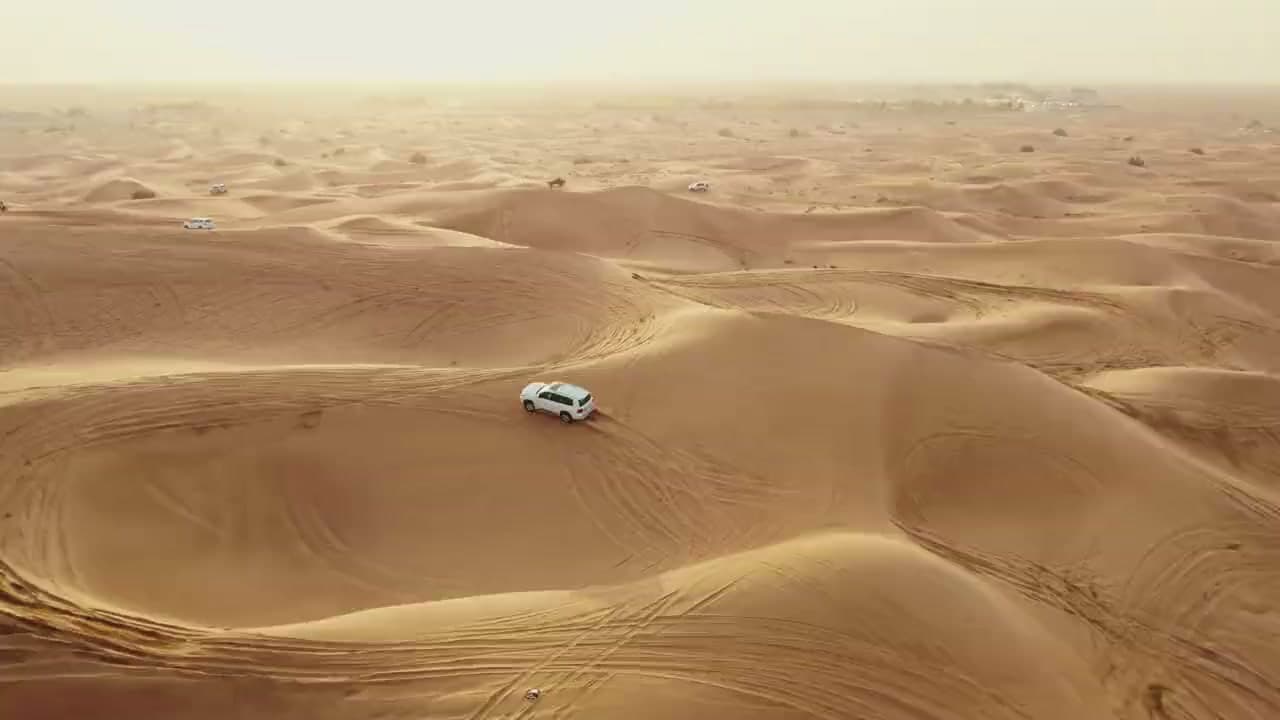
The evening safari is the volume product of Dubai inbound tourism, and its shape is consistent across operators. Hotel pickup is mid-afternoon in a 4x4 — typically six guests per vehicle on a shared basis, or a private vehicle on request. The convoy transfers to a dune-driving area, tyres are deflated, there is a dune-bashing run and a sunset photo stop, then the convoy moves to a permanent desert camp for activities, dinner and a show. Drop-off is late evening.
End to end it is roughly six hours, commonly quoted as approximately 16:00 to 22:00. That window moves earlier in winter as sunset moves, which is the most common reason a guest ends up waiting in the wrong lobby at the wrong time.
What is normally included
- Return hotel transfers
- Dune bashing in a 4x4
- A sunset stop and photo opportunity
- A short camel ride at the camp
- Sandboarding
- Henna painting
- Arabic coffee, dates and soft drinks
- A BBQ or international buffet dinner, with vegetarian options
- Live entertainment — commonly Tanoura, belly dance and a fire show
- Shisha in a majlis seating area
Pickup is from your hotel, so transfer time depends on where that hotel is: a Deira address is a different journey from a Palm Jumeirah address. If the hotel is not booked yet, our guide to where to stay in Dubai compares the districts on exactly that.
Morning safari — the summer, family and stopover answer
A morning safari is the same excursion, shorter and earlier, built around dune driving in the cooler part of the day and without the camp dinner and show. Pickup is early — commonly before sunrise or shortly after — then the dunes, dune bashing, sandboarding, a camel ride, refreshments, and back at the hotel by late morning. Four to five hours door to door. Included as standard: return transfers, dune bashing, sandboarding, a short camel ride, and refreshments or a light Arabic breakfast depending on the package. What you give up is the camp evening — the buffet, the shisha majlis and the show are evening inclusions and are not replicated.
It is the right answer more often than it is sold. It is the preferred format June to September, when afternoon heat makes an evening safari uncomfortable until quite late, and the light beats an evening safari's dusk arrival. Operationally it is the only safari that fits a cruise-call day, a long-layover stopover, or a client with an evening flight or MICE commitment — and it pairs with an afternoon city tour to make a full day.
Overnight in the desert — and what to ask before you book it
An overnight is an evening safari extended to a night under canvas, with a sunrise element the next morning. Afternoon pickup is as per an evening safari; once the entertainment finishes and day guests leave, overnight guests stay on. Sleeping is in a Bedouin-style tent — operators describe a Nawar bed with pillows and blankets — with shared or private washrooms depending on camp grade. Guests wake for sunrise, take a short camel trek or dune walk, have breakfast and are driven back mid-morning. It is widely marketed at approximately 12 to 18 hours; a common structure is a 14:30 pickup and a return around 08:30.
Camp comfort varies enormously here, from basic shared-facility tents to fully serviced private ones, and the phrase Bedouin-style covers both. Grade has to be confirmed at booking, not assumed. Ask these five questions first.
- 01What grade is the camp, and what does that mean for the tent and the bedding?
- 02Are washrooms shared or private, and where are they relative to the tent?
- 03Is there power at the tent, and for how many hours of the night?
- 04Is the camp exclusive-use for the night, or are other groups staying?
- 05Is the camp inside a conservation reserve or on open desert?
The conservation reserve difference — why a permit changes the product
This is the part of the category almost nobody explains, and the one structural fact that makes a safari claim checkable. The Dubai Desert Conservation Reserve is a 225 km² protected inland-desert reserve, described on its own site as the UAE's first national park and created in 2003 by special Ruler's Decree. It is governed by the Dubai Desert Conservation Board, chaired by HH Sheikh Ahmed bin Saeed Al Maktoum.
Access is controlled. The conservation team does not operate tours itself; a limited set of concession-holding operators is permitted to run activities inside, and there is no independent 4x4 entry. Arabian Adventures states on its own site that it is one of only a handful of companies permitted to operate inside the protected reserve. That access regime is the product: it caps volume, fixes the routes vehicles may drive, and requires reserve-certified guiding.
Selling a safari in the DDCR is a factual, checkable claim. Selling a luxury desert safari is not.
The reserve is segregated into four zones with different rules. A Wilderness Zone is for research and observation on foot only; a Rehabilitation Zone carries habitat infrastructure only; an Ecotourism Activities Zone allows low-impact activity such as nature walks and camel and horse rides. Only the Development and Recreation Zone carries approved safari operators, dune driving on pre-planned routes and small dune dinner camps. That zoning is why a reserve drive feels nothing like an open-desert convoy: the route is fixed.
On wildlife, the reserve supports the largest free-roaming herd of Arabian oryx in the UAE, reintroduced from a founder group released in 1999, alongside Arabian gazelle and sand gazelle — the three ungulate species IUCN names for the reserve. We publish no population figures, because the numbers in circulation come from a page we could not read on the date we checked and they contradict each other. A realistic prospect of seeing free-roaming oryx and gazelle on a guided drive is the honest claim; a headcount is not.
A second reserve is a different kind of product. Al Marmoom Desert Conservation Reserve, established in January 2018 and managed by Dubai Municipality, is described as the first unfenced nature conservation reserve in the UAE. Being unfenced and publicly accessible makes it the home of softer, culture-led product — camel caravans, Bedouin village hospitality, falconry displays, Emirati food, stargazing and birdwatching at Al Qudra Lakes — rather than high-adrenaline dune driving. It carries around 10 km of lakes and an 84 km cycling track, and contains the Saruq Al Hadid archaeological site, an Iron Age metallurgical centre discovered in 2002.
For an agent, the practical consequence of the permit regime is capacity. Vehicle numbers and camps inside the reserve are capped, so reserve product sells out earlier than open-desert product, particularly for December to February and for anything group-sized. Book it further ahead than a standard evening safari.
Premium and private safaris — what you are actually buying
A premium safari is a low-volume, guide-led experience that replaces dune bashing and mass camps with a wildlife drive, falconry, an exclusive or small camp and a plated or multi-course meal. Roughly six to seven hours. The two credible premium formats in Dubai are vintage open-top Land Rover heritage safaris and modern Land Rover Defender luxury safaris. Normally excluded, and worth stating plainly: overnight accommodation, a hot air balloon flight, and a private vehicle unless specified.
Because premium is an adjective anyone can print, here is one operator's published specification as an example of what the format means in practice. Platinum Heritage publishes its Heritage Desert Safari, operating inside the Dubai Desert Conservation Reserve, as approximately seven hours: hotel pickup between 14:00 and 16:30 with the exact time given around midday on the day of travel, drop-off between 21:30 and 23:30, transfers in a shared air-conditioned vehicle. Guests receive a traditional headscarf and a stainless-steel water bottle, take a 60-minute nature safari in a vintage Land Rover with a conservation guide — some vehicles seat up to ten, private vehicle on request — watch a falcon performance at sunset, then reach a Bedouin camp for Arabic coffee and dates, bread-making, coffee-making, henna and camel-ride stations, a four-course traditional dinner and interactive drumming and Yola performances.
The number that matters most there is the camp capacity: the operator states its camp is restricted to 75–100 guests. That is a checkable figure you can ask any operator selling you a premium evening to match, and most cannot. It is worth more than every adjective in a brochure. All of the above is Platinum Heritage's published description of its own product, cited as an example of the format — it is not our specification, and not a claim about every premium operator.
The same operator publishes restrictions typical of the format and easy to get caught by: children aged 5–11 are charged at a child rate and a private car is required for children under 5; the nature drive is not recommended after six months of pregnancy; warm clothing is advised November to March. For reserve-based product, a share of the fee going to conservation is a common and defensible selling point. Agents building incentives should ask us about private convoys and dedicated camp tables directly.
The add-ons: quad bikes, camels, sandboarding, falconry and balloons
Dune buggies and quad bikes
Sold standalone or as a safari add-on, commonly in 30-minute and 60-minute blocks. Guests get a safety briefing and protective equipment, then ride a marked circuit or a guided route behind a lead rider. Operator and industry sources referencing Dubai legislation consistently state a minimum rider age of 16 for recreational quad bikes and dune buggy drivers, and describe helmets as mandatory for every rider and passenger on licensed tours. Child passenger minimums vary by operator.
Camel rides and camel caravans
Two different things are sold under one word. A camp ride is a few minutes on a led camel and is standard inclusion on evening and morning safaris. A caravan trek in Al Marmoom or the DDCR is longer and guide-led, often ending at a Bedouin camp for a meal; the legs are short and repeated across a session rather than run as one long trek. The part guests find hardest is not the ride but the mounting and dismounting, because the camel kneels and rises sharply. Not suitable for guests with back or hip problems, or late-stage pregnancy.
Sandboarding
Included in almost every safari package at no extra charge, so do not accept it as an upgrade. Boards are carried in the safari vehicle; the driver-guide picks a suitable dune during the dune-driving leg, waxes the board and supervises the runs. Most guests ride seated or prone rather than standing. Ten to twenty minutes as part of a safari stop.
Falconry
Also two formats. A camp or in-safari falcon show at sunset, where a falconer flies the bird to a lure and guests photograph it on the glove, is standard inclusion and should never be sold as exclusive. A dedicated falconry safari is different: a 4x4 nature drive looking for houbara bustard, Arabian oryx and sand gazelle, then a supervised session at an Emirati falcon hunting camp where guests handle and fly the birds themselves. Falconry is an established in-reserve activity — DDCR's own history dates its Royal Shaheen partnership to 2011. We publish no duration for either, because the figures in circulation come from listing pages rather than operators' own sites.
Hot air balloon at sunrise
A sunrise flight over the Dubai Desert Conservation Reserve, usually sold as an add-on to a safari rather than instead of one. Hero Balloon Flights, trading as Balloon Adventures Emirates, publishes the detail on its own FAQ, re-checked on 29 July 2026: the flight is between 45 and 60 minutes depending on weather, reaching up to 4,000 ft over the reserve, with five to six hours total from pickup to drop-off. Pickup falls between 03:30 and 05:30, varying with seasonal sunrise, and the driver confirms the exact location the day before; pickup is available anywhere in Dubai, or guests can meet at the Dubai Outlet Mall Dome entrance.
The eligibility rules are strict. The operator states a minimum age of 7; passengers over 60 require an additional signed waiver; and it will not fly guests who are pregnant, who have had major surgery or a broken arm or leg in the past six months, or who have chronic back or neck pain. If a flight is cancelled for weather, its stated policy is a full refund or a rebooking — and if conditions deteriorate after arrival at the launch site, guests have breakfast first and the flight is reassessed.
What goes wrong — and how to avoid it
Six things account for almost every unhappy safari. None is exotic, and all six are fixable at the point of booking rather than on the day.
1. Motion sickness in the dunes
Dune bashing is genuinely physical and motion sickness is common — that is what the vehicle does, not a failure of nerve. It is normally not recommended for pregnant guests, people with back, neck or heart conditions, or very young children. The fix is a different format: a morning safari is shorter, a premium reserve safari replaces dune bashing with a nature drive, and an Al Marmoom experience has no dune driving at all.
2. A camp with a thousand other people in it
Standard safari camps are large and shared. If the picture in your head is a quiet fire and a starlit dinner, a volume evening safari will not deliver it at any price. Book a conservation-reserve or private-camp product instead, and get a camp capacity figure you can hold the operator to.
3. An overnight camp whose grade was never stated
Overnight comfort ranges from basic shared-facility tents to fully serviced private ones. Confirm washroom facilities, power and exclusive-use status at booking. That single check removes most overnight complaints.
4. Refused at the dunes on an age rule
The quad bike and buggy age rule is the most common cause of a refused activity at the dunes, almost always because nobody confirmed it against that operator's own current terms. Confirm it in writing, per operator, before you leave the hotel.
5. A balloon that never flies
Balloon flights are seasonal, weather-dependent and capacity-limited. The operator's refund policy protects your money but cannot give you back the morning. Never plan a balloon as a fixed itinerary item on a single-night stay, and never sequence it after a late gala dinner — pickup is pre-dawn.
6. The wrong desert entirely
The most expensive mistake and the hardest to see in a quote. Confirm whether the operator is running inside a conservation reserve or on open, unprotected desert: it changes the landscape, the wildlife, the route rules, the guiding and the camp. It changes the product materially, and it is the one variable a price comparison completely hides. Vetting operators on that question, and on vehicle age and guide certification, is a core part of what we do as a DMC.
What to wear and bring
Loose, comfortable clothing and closed shoes — open shoes fill with sand at the first dune stop and stay that way. Bring a hat, sunglasses and sunscreen for daylight, and add a layer for winter evenings, because desert temperatures drop sharply after sunset and Dubai's January average night-time low is around 17°C. On a December or January evening a light jacket is genuinely needed after dark, and for an overnight in November to February warm layers are essential rather than optional.
More generally, the UAE government portal advises visitors to dress modestly, particularly in conservative areas and public places, and recommends loose-fitting clothing covering shoulders, arms and legs. A desert camp is relaxed, but the same principle applies to any cultural stop you pair with the safari — and at mosques women must wear an abaya and a head covering, typically provided on site.
When to go into the desert
October to April is the desert season, and November to March is the widely cited best window overall: average daytime maxima are 25°C in January, 26°C in February, 27°C in December and 31°C in November. Outdoor product concentrates there — safaris, desert galas, balloon flights and overnights all work, and reserve product sells out first.
April and May are the pivot: average maxima climb to 32°C and 37°C, outdoor activity moves to early morning and late afternoon, and safaris shift later in the day. June to September averages 39–41°C, and in that window the morning safari is the sensible format while an evening safari only becomes comfortable quite late. October restarts the season — evenings become comfortable, humidity drops, and it is the best-value month with genuinely good conditions. If the dates are still open, our month-by-month guide to the best time to visit Dubai sets the desert season against the rest of the calendar.
Common questions
- Is a morning or evening desert safari better?
- Evening if you want the full experience: dune bashing, a sunset stop, a camp, dinner and live entertainment, roughly six hours end to end. Morning if you are travelling June to September, have young children, are prone to motion sickness, have an evening flight or are on a cruise call — it runs approximately four to five hours in the cooler part of the day and gives better light for photography, but it carries no camp dinner or show.
- What is included in a Dubai desert safari?
- A standard evening safari normally includes return hotel transfers, dune bashing in a 4x4, a sunset stop, a short camel ride at the camp, sandboarding, henna painting, Arabic coffee, dates and soft drinks, a BBQ or international buffet dinner with vegetarian options, live entertainment — commonly Tanoura, belly dance and a fire show — and shisha in a majlis area. A morning safari includes transfers, dune bashing, sandboarding, a short camel ride and refreshments or a light Arabic breakfast, depending on the package.
- What is NOT included in a Dubai desert safari?
- Five things are usually charged separately: the quad bike or dune buggy add-on, alcoholic beverages, a private vehicle upgrade, VIP or raised seating and a private table at the camp, and the falcon photo opportunity. On a premium safari, overnight accommodation, a hot air balloon flight and a private vehicle are also normally excluded unless specified. Confirm all of them in writing before comparing two quotes.
- Is dune bashing safe if you get motion sickness?
- Dune bashing is genuinely physical and motion sickness is common. It is normally not recommended for pregnant guests, people with back, neck or heart conditions, or very young children. If any of that applies, book a format that avoids it: a premium conservation-reserve safari replaces dune bashing with a nature drive, and a culture-led Al Marmoom experience — camel caravan, Bedouin hospitality, stargazing — has no dune driving at all.
- What is the difference between a desert safari and a conservation-reserve safari?
- Access. The Dubai Desert Conservation Reserve is a 225 km² protected reserve created in 2003, and the conservation team does not run tours itself — only a limited set of permitted concession holders may operate inside, and there is no independent 4x4 entry. That means capped volume, dune driving on predefined routes and reserve-certified guides, alongside free-roaming Arabian oryx and gazelle. A generic safari on unprotected desert has none of those constraints. Whether a given operator currently holds a permit must be confirmed with the reserve.
- What is the minimum age for a desert safari or quad bike in Dubai?
- Safaris themselves carry no universal minimum age, though dune bashing is normally not recommended for very young children. For quad bikes and dune buggies, operator and industry sources referencing Dubai legislation consistently state a minimum rider age of 16, with helmets mandatory for every rider and passenger on licensed tours and child passenger minimums varying by operator. We have not been able to retrieve the legislation itself, so treat that as what operators state rather than as law, and confirm it against the operator's own current booking terms in writing.
- How long does a Dubai desert safari take?
- A morning safari runs approximately four to five hours door to door. An evening safari runs roughly six hours, commonly quoted as approximately 16:00 to 22:00 and shifting earlier in winter as sunset moves. A premium safari runs approximately six to seven hours. An overnight is marketed at approximately 12 to 18 hours, commonly a 14:30 pickup and a return around 08:30 the next morning.
- What should I wear on a desert safari?
- Loose, comfortable clothing and closed shoes — open shoes fill with sand at the first stop. Bring a hat, sunglasses and sunscreen for daylight, and add a layer for winter evenings, because desert temperatures drop sharply after sunset and Dubai's January average night-time low is around 17°C. For an overnight in November to February, warm layers are essential. If the day includes a mosque visit, women must wear an abaya and a head covering, usually provided on site.
- Can you do a desert safari in summer?
- Yes, but book the morning format. Safaris sell year-round and are far more comfortable October to April; average daytime maxima run 39–41°C from June to September, which is why the morning safari is the preferred format in those months. Overnight camps are realistically an October to April product, and hot air balloon flights do not operate through the summer.
Sources
Checked 29 July 2026. Travel rules, opening hours and event dates change — we confirm current details for every booking.
- IUCN — Dubai Desert Conservation Reserve member page
- Dubai Desert Conservation Reserve — Wikipedia
- Arabian Adventures — an introduction to the DDCR
- Arabian Adventures — destination management services, travel trade
- Platinum Heritage — Heritage Desert Safari product page
- Hero Balloon Flights / Balloon Adventures Emirates — FAQ
- Hero Balloon Flights / Balloon Adventures Emirates — homepage
- Al Marmoom Desert Conservation Reserve — Wikipedia
- UAE Government portal (u.ae) — social responsibility and dress
- UK FCDO — United Arab Emirates travel advice, safety and security
- Dubai monthly climate averages (Copernicus C3S 1991–2020 normals)
- Quad biking Dubai age limit — operator-published age rule, not legislation